What Does a Chinese Furniture Manufacturer Actually Do From the Day You Place an Order to the Day It Arrives on Site?
Most people who order custom furniture from China have a rough idea of the timeline — “somewhere between 6 and 12 weeks” — but very little sense of what’s actually happening during that time. The order goes in, weeks pass, and eventually a container arrives. What happens in between is largely invisible.
That invisibility creates problems. When buyers don’t understand the process, they can’t tell the difference between a normal delay and a serious one. They don’t know which moments require their input and which ones don’t. They approve things they shouldn’t and push back on things that don’t matter. And when something goes wrong, they have no framework for understanding where in the process it went wrong or why.
This piece walks through what actually happens, step by step, from the day a purchase order is confirmed to the day your furniture arrives on site. Not as a factory tour, but as a practical guide to understanding a process you’re paying for and should be able to navigate.
Before Production Even Starts: The Setup Nobody Sees
The first thing that happens after you confirm an order is not production. It’s preparation — and this phase takes longer than most buyers expect.
Material procurement. The factory places orders with their board suppliers, hardware suppliers, and surface material suppliers. For custom specifications — a non-standard board grade, a specific hardware brand, a color that requires special dyeing or film — this procurement step can add 1–2 weeks before a single panel is cut. Standard specifications pull from existing inventory; custom specifications do not. This is one of the reasons custom orders consistently take longer than catalog orders, and why specifying materials precisely at the quote stage (rather than finalizing them after order placement) matters so much.
Production scheduling. Your order goes into the factory’s production queue. Where it falls in that queue depends on when you ordered, what else is running, and how the factory manages production flow. A factory running at 80% capacity might schedule your order to start in three weeks. One running at full capacity in peak season might be looking at six weeks before your production begins. This scheduling step is completely normal, and it’s one of the reasons manufacturers quote lead times with ranges rather than exact dates — they don’t always know exactly where you’ll land in the queue when you place the order.
Technical drawing preparation. For custom dimensions, the factory’s technical team prepares cutting plans and assembly drawings from your specifications. This is where errors in the original specification get caught — or don’t get caught. A good factory reviews the technical drawings against your purchase order before production begins. A less careful one starts cutting and discovers the problem later.
If you’re ordering across multiple product categories — kitchen cabinets, wardrobes, bathroom vanities, interior doors — all of this setup happens in parallel for each category. The production schedules may not align perfectly, which is one reason that ordering everything from one manufacturer (where scheduling is coordinated) produces better results than four separate supplier relationships running on four separate timelines.
Week 1–2: Cutting and Forming
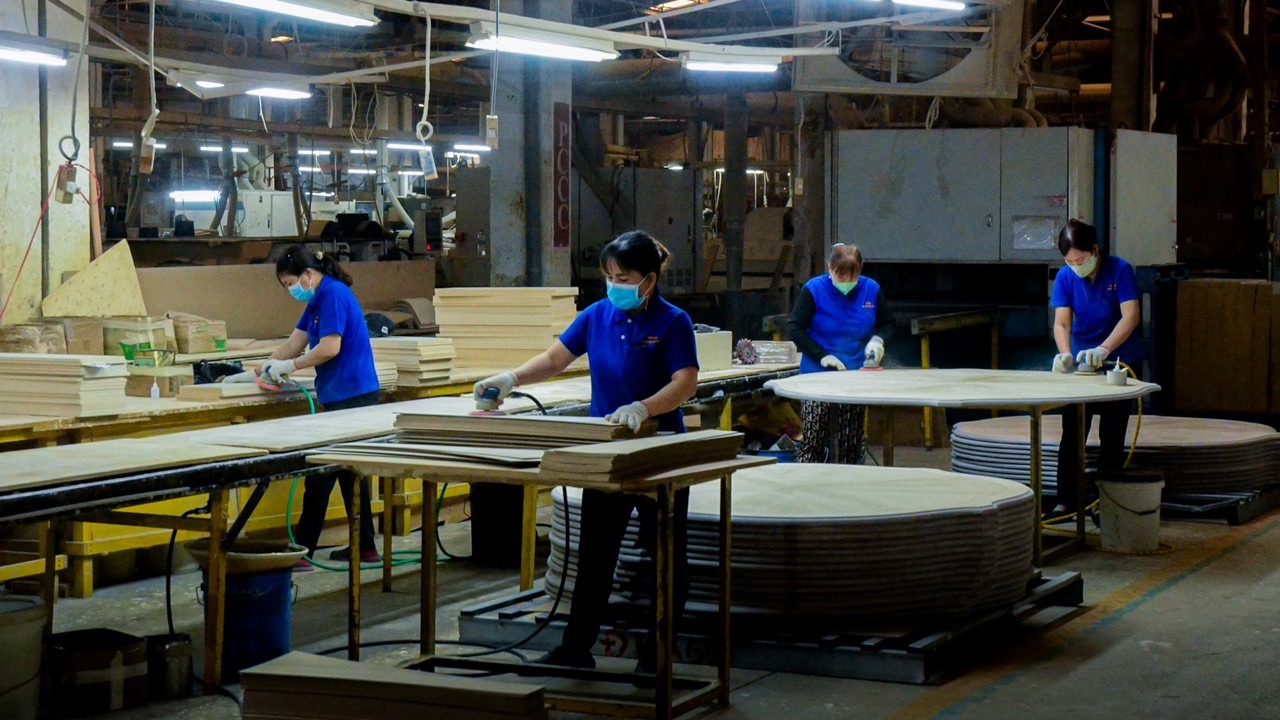
The visible production begins with cutting. Panels of board material — MDF, particleboard, or solid wood depending on your specification — are cut to size using CNC cutting machines. At a well-equipped factory, this process is highly automated and precise: the cutting program comes directly from the technical drawings, and tolerances of ±0.5mm are standard.
After cutting comes edge banding — the process of applying a thin strip of material to the raw cut edge of each panel to seal it and give it a finished appearance. Edge banding quality is one of the most telling indicators of overall production quality. On good furniture, edge banding is flush with the panel surface, consistent in color, and firmly adhered even at corners. On lower-quality production, it’s slightly raised, inconsistent in color, or peeling at corners. These issues are almost always visible on the finished piece and are a common point of rejection in pre-shipment inspections.
For doors — kitchen cabinet doors, wardrobe doors, interior doors — additional processes happen here: shaping of the door profile if it has a raised panel or routed edge, surface application (the MDF core gets wrapped in PVC film, lacquered, or veneered), and any glass or insert installation.
Surface finishing, particularly lacquering, happens in a spray booth environment where temperature and humidity are controlled. For high-gloss lacquer especially, the finishing environment matters significantly — inconsistencies in either produce visible defects in the final surface. This is also where color calibration happens: the finish is matched against the approved color standard, and color consistency is verified before proceeding.
Week 2–4: Assembly and Hardware Installation
Cut and finished panels go to the assembly area, where cabinet boxes are constructed and hardware is installed.
Cabinet box assembly is largely mechanical: panels are connected using cam locks, dowels, or screws in precisely drilled positions. The accuracy of the drilling — position and depth — determines whether the assembled box is square, whether doors hang straight, and whether drawer slides operate correctly. Drilling errors that aren’t caught at this stage become fit and function problems in the finished piece.
Hardware installation is where much of the quality differentiation becomes tangible. Soft-close hinges need to be adjusted to the correct opening angle and closing speed. Drawer slides need to be aligned so drawers travel smoothly and return to center. Lift mechanisms in wardrobe systems need to operate with consistent force. These are adjustable, but they need to be set correctly — and “correctly” means operating the way the end user will experience them, not just being mechanically connected.
For walk-in wardrobe systems and kitchen cabinet runs, pre-assembly verification happens here: the factory assembles sections of the order to verify that everything fits together as designed before it’s packed for shipping. This is particularly important for configurations that need to connect across multiple pieces — a continuous kitchen cabinet run, for example, where the height and alignment of adjacent cabinets needs to be consistent.
For bathroom vanities, plumbing hardware and basin mounting hardware may also be installed at this stage if specified, depending on the product design.
Quality Control: The Step That Separates Good Factories from Average Ones
Before anything is packed, finished pieces go through quality inspection. What this looks like in practice varies enormously between factories, and it’s one of the most important things to ask about when you’re evaluating a manufacturer.
At a minimum, quality inspection should include: dimensional verification against the approved technical drawings, surface finish check for defects (scratches, bubbles, uneven color, edge banding issues), hardware function test (every hinge, drawer, door, and mechanism operated at least once), and structural check (no loose connections, panels correctly aligned and secured).
At a better factory, inspection also includes: color comparison against the approved sample under standardized lighting, documentation of each inspected piece with batch records, and statistical sampling that pulls enough units to catch systematic problems rather than just individual defects.
The practical implication for buyers: ask specifically what the inspection process looks like. How many pieces are inspected? What documentation is generated? What happens to a piece that fails inspection — is it reworked and re-inspected, or scrapped? A factory with a real quality system will have clear answers. One without one will give you reassurance rather than specifics.
Packing and Container Loading
Approved pieces are wrapped and packed for shipping. This step matters more than buyers usually expect.
Custom furniture is almost always shipped in flat pack or partially assembled form to reduce volume and therefore shipping cost. Assembly instructions need to be included, hardware needs to be packaged separately and clearly labeled, and protective wrapping needs to prevent surface damage during the movement and vibration of ocean transit.
Damage during shipping is one of the most common causes of quality problems on arrival, and most of it is preventable. Corners and edges are the most vulnerable points — on lacquered finishes especially, a corner that’s not padded correctly will arrive with a chip. High-gloss surfaces need individual wrapping, not just stacking. Cabinet doors need to be packed separately from cabinet boxes, not installed and shipped assembled.
The container loading sequence also matters. Heavy items go in first, fragile items loaded last. If multiple product categories are in the same container — which is one of the advantages of sourcing from a single manufacturer — the loading plan needs to account for the delivery sequence on site, so the first items to be installed aren’t buried under everything else.
Ocean Freight: What’s Happening While You Wait
Once the container is sealed and picked up, it goes to the port for loading onto a vessel. Transit time from Chinese ports to most markets: 3–5 weeks to the Middle East, 3–4 weeks to Southeast Asia, 4–6 weeks to Australia and Europe, 4–5 weeks to the US West Coast.
Nothing is happening to your furniture during this time except moving, which is actually the point. But this is the period when buyers most commonly discover they forgot to do something before shipment. The pre-shipment inspection they didn’t arrange. The assembly instructions they forgot to confirm were in the language they need. The installation hardware that wasn’t included.
These things can sometimes be addressed with a supplementary shipment, but at much higher cost per item than including them in the original container. The better approach is a pre-shipment checklist reviewed before the container is sealed — covering not just the furniture itself but everything that needs to arrive with it for installation to proceed.
Customs Clearance and Final Delivery
When the container arrives at the destination port, customs clearance begins. Required documents include the commercial invoice, packing list, bill of lading, and — depending on your market — certificates of conformity for formaldehyde standards (E1, CARB Phase 2, or equivalent for your market), FSC chain of custody documentation if specified, and any other import compliance documentation your country requires.
Missing or incorrect documentation is one of the most common causes of customs delays. Formaldehyde certification documents that reference a different product specification than what’s in the container, certificates issued to the factory name but under a different company structure than the exporter of record, country-of-origin documentation that doesn’t match the actual production location — all of these create delays that are measured in weeks, not days.
After customs release, goods move to a local warehouse or directly to site. Final delivery to a construction site has its own logistics: elevator access, floor protection requirements, the sequencing of delivery relative to other trades on site. For a multi-unit residential project, this means coordinating the delivery and distribution of furniture across potentially hundreds of apartments — and the people doing that coordination are usually not the manufacturer, but whoever is managing the project on the ground.
Why This Process Takes as Long as It Does
The honest answer is that each step takes real time, and the steps are sequential. You can’t start assembly before cutting is complete. You can’t ship before inspection is done. You can’t clear customs before the ship arrives.
The total elapsed time for a standard custom furniture order from a Chinese manufacturer — from purchase order to goods on site — runs 12–18 weeks for a straightforward project at a factory you’ve worked with before. For a first-time engagement, add the sample process (8–12 weeks) before production even begins, and you’re looking at 5–7 months total from brief to delivery.
Most project delays happen for one of three reasons: the buyer underestimated how long the process takes and started too late; something in the specification changed after production began, requiring rework; or a quality problem discovered at inspection required additional production time to correct.
The first is a planning problem. The second is a specification discipline problem. The third is a supplier quality system problem.
All three are manageable with the right approach: build the full timeline into your project plan from the start, lock down specifications before confirming production, and choose a manufacturer with a quality system robust enough to catch problems before they become container loads of defective furniture.
What This Means When You’re Choosing a Manufacturer
Understanding this process changes what you look for in a supplier.
A manufacturer who can explain each of these steps clearly — who can tell you exactly how their production scheduling works, what their quality inspection process involves, and what documentation they provide at each stage — is showing you that they understand their own process well enough to manage it for your project.
A manufacturer who gives you vague answers about lead times, glossy descriptions of their equipment without specifics about their process, or reassurances about quality without details of how quality is actually controlled — is telling you that either they don’t have good systems or they don’t think you’ll ask.
When you visit the official website of any furniture manufacturer you’re considering, look for evidence that they’ve built systems around this process: project management capability, documentation of certifications, and evidence of experience with projects at the scale and complexity of yours. A factory that handles kitchen cabinets, wardrobes, bathroom vanities, and interior doors from a single production base isn’t just offering convenience — they’re offering coordinated scheduling, consistent materials, and a single quality system that applies across everything you’re buying.
That coordination matters most in the steps that aren’t visible: the production scheduling that keeps your project on track, the quality inspection that catches problems before they ship, the technical review that catches specification errors before cutting begins. These are the steps that determine whether the furniture that arrives on site matches what you approved — and whether it arrives when your project needs it.